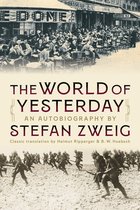
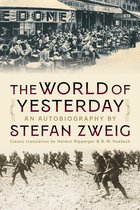
The World of Yesterday - An Autobiography Classic Translation by Helmut Ripperger and B.W. Huebsch
Vraag het Shophulp, de AI-assistent van bol
Auteur:
Uitgever:
Verteller(s):
EngelsPaperback979835050285508 september 2026404 pagina's

Stefan Zweig
"Net als zijn grote vriend Joseph Roth zwierf Stefan Zweig (1881-1942) na de opkomst van de nationaalsocialisten jarenlang door Europa, gescheiden van zijn thuisland. Uiteindelijk vestigde hij zich in Brazilië, waar hij in 1942 samen met zijn vrouw zelfmoord pleegde. Op bol.com vind je alle boeken van Stefan Zweig.
(Foto: Wikipedia. Beschikbaar onder de licentie Creative Commons Naamsvermelding/Gelijk delen.)"
Alles van Stefan Zweig(Foto: Wikipedia. Beschikbaar onder de licentie Creative Commons Naamsvermelding/Gelijk delen.)"
Samenvatting
It’s been said that the past is another country. Stefan Zweig’s memoir The World of Yesterday takes readers into several such countries.
This book has been called the most famous work about the Hapsburg Empire of Austria-Hungary (which Zweig calls “the world of security”) in the last decades before its collapse in the First World War. Zweig, an Austrian Jew born and raised in Vienna in 1881, pays a haunting tribute to his vanished nation in this memoir, completed just before his death. He opens by describing a comfortable childhood in bourgeois Vienna; a dismal and discouraging educational system; student life, with its duels and drinking; and the furtive and repressed sexuality of the early twentieth century.
Zweig goes on to talk about his lifelong encounters with great writers, thinkers, and artists, such as Sigmund Freud, Auguste Renoir, Romain Rolland, and Rainer Maria Rilke, many of whom he counted as close friends.
Zweig reached the height of his success in the 1920s and 1930s, when he was one of the world’s most widely read literary figures, with numerous biographies and fictional works such as Letter from an Unknown Woman and Beware of Pity.
But the shadow of Nazism was falling over Central Europe at that time, and in 1933, Zweig’s works were banned by the Third Reich. When Germany annexed Austria in 1938, his fled his native country, moving first to England, then to the United States, and finally to Brazil, where he and his wife committed joint suicide in 1942. In his farewell note, he wrote, “I think it better to conclude in good time and in erect bearing a life in which intellectual labour meant the purest joy and personal freedom the highest good on earth.”
Zweig’s memoir—moving, insightful, sensitive, and historically rich—was completed shortly before his death. It recalls to memory a shimmering, vibrant, but doomed Europe over a century ago.
This beautifully designed, easy-to-read modern edition features an index.
Productspecificaties
Inhoud
- Taal
- en
- Uitvoering
- Paperback
- Oorspronkelijke releasedatum
- 08 september 2026
- Aantal pagina's
- 404
Vertaling
- Eerste Vertaler
- Tweede Vertaler
Betrokkenen
- Hoofdauteur
- Tweede Auteur
- Verteller
- Hoofduitgeverij
Informatie over de fabrikant
- Fabrikant Naam
- Libri GmbH
- E-mailadres of online contactformulier van de fabrikant
- gpsr@libri.de
- Fabrikantgegevens
- De overige informatie van de fabrikant is momenteel niet beschikbaar.
Overige kenmerken
- Porno
- Nee
- Product breedte
- 152 mm
- Product hoogte
- 12 mm
- Product lengte
- 228 mm
- Studieboek
- Nee
- Verpakking breedte
- 129 mm
- Verpakking hoogte
- 10 mm
- Verpakking lengte
- 147 mm
EAN
- EAN
- 9798350502855
Productveiligheid
De verantwoordelijk marktdeelnemer in de EU zorgt voor het nakomen van verplichtingen op het gebied van productveiligheid.
Je vindt dit artikel in
Documenten
Reviews
Nog geen reviews
Kies gewenste uitvoering
Kies je uitvoering
Verwacht over 4 weken
Prijs inclusief verzendkosten, verstuurd door bol
Ophalen bij een bol afhaalpunt mogelijk
30 dagen bedenktijd en gratis retourneren via mijn bol
Dag en nacht klantenservice
Doordeweeks ook ’s avonds in huis
Bekijk ook eens


Anderen bekeken ook
Bekijk de hele lijst