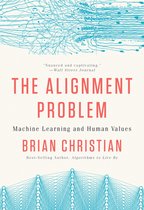
The Alignment Problem Machine Learning and Human Values
Auteur:
Uitgever:
EngelsPaperback978039386833305 oktober 2021496 pagina's
Brian Christian
Brian Christian is computerdeskundige, dichter en filosoof. Behalve in wetenschappelijke tijdschriften, heeft hij ook inMcSweeneysenThe Seneca Reviewgepubliceerd.Een wedstrijd in menselijkheidis zijn eerste boek. Op bol.com vind je alle boeken van Brian Christian, waaronder het nieuwste boek van Brian Christian.
Alles van Brian ChristianSamenvatting
"If you’re going to read one book on artificial intelligence, this is the one." —Stephen Marche, New York Times A jaw-dropping exploration of everything that goes wrong when we build AI systems and the movement to fix them.
Today’s “machine-learning” systems, trained by data, are so effective that we’ve invited them to see and hear for us—and to make decisions on our behalf. But alarm bells are ringing. Recent years have seen an eruption of concern as the field of machine learning advances. When the systems we attempt to teach will not, in the end, do what we want or what we expect, ethical and potentially existential risks emerge. Researchers call this the alignment problem. Systems cull résumés until, years later, we discover that they have inherent gender biases. Algorithms decide bail and parole—and appear to assess Black and White defendants differently. We can no longer assume that our mortgage application, or even our medical tests, will be seen by human eyes. And as autonomous vehicles share our streets, we are increasingly putting our lives in their hands. The mathematical and computational models driving these changes range in complexity from something that can fit on a spreadsheet to a complex system that might credibly be called “artificial intelligence.” They are steadily replacing both human judgment and explicitly programmed software. In best-selling author Brian Christian’s riveting account, we meet the alignment problem’s “first-responders,” and learn their ambitious plan to solve it before our hands are completely off the wheel. In a masterful blend of history and on-the ground reporting, Christian traces the explosive growth in the field of machine learning and surveys its current, sprawling frontier. Readers encounter a discipline finding its legs amid exhilarating and sometimes terrifying progress. Whether they—and we—succeed or fail in solving the alignment problem will be a defining human story. The Alignment Problem offers an unflinching reckoning with humanity’s biases and blind spots, our own unstated assumptions and often contradictory goals. A dazzlingly interdisciplinary work, it takes a hard look not only at our technology but at our culture—and finds a story by turns harrowing and hopeful.
Today’s “machine-learning” systems, trained by data, are so effective that we’ve invited them to see and hear for us—and to make decisions on our behalf. But alarm bells are ringing. Recent years have seen an eruption of concern as the field of machine learning advances. When the systems we attempt to teach will not, in the end, do what we want or what we expect, ethical and potentially existential risks emerge. Researchers call this the alignment problem. Systems cull résumés until, years later, we discover that they have inherent gender biases. Algorithms decide bail and parole—and appear to assess Black and White defendants differently. We can no longer assume that our mortgage application, or even our medical tests, will be seen by human eyes. And as autonomous vehicles share our streets, we are increasingly putting our lives in their hands. The mathematical and computational models driving these changes range in complexity from something that can fit on a spreadsheet to a complex system that might credibly be called “artificial intelligence.” They are steadily replacing both human judgment and explicitly programmed software. In best-selling author Brian Christian’s riveting account, we meet the alignment problem’s “first-responders,” and learn their ambitious plan to solve it before our hands are completely off the wheel. In a masterful blend of history and on-the ground reporting, Christian traces the explosive growth in the field of machine learning and surveys its current, sprawling frontier. Readers encounter a discipline finding its legs amid exhilarating and sometimes terrifying progress. Whether they—and we—succeed or fail in solving the alignment problem will be a defining human story. The Alignment Problem offers an unflinching reckoning with humanity’s biases and blind spots, our own unstated assumptions and often contradictory goals. A dazzlingly interdisciplinary work, it takes a hard look not only at our technology but at our culture—and finds a story by turns harrowing and hopeful.
Productspecificaties
Inhoud
- Taal
- en
- Uitvoering
- Paperback
- Oorspronkelijke releasedatum
- 05 oktober 2021
- Aantal pagina's
- 496
- Kaarten inbegrepen
- Nee
- Illustraties
- Nee
Vertaling
- Originele titel
- The Alignment Problem: Machine Learning and Human Values
Betrokkenen
- Hoofdauteur
- Hoofduitgeverij
- Tweede Uitgeverij
Informatie over de fabrikant
- Fabrikant Naam
- Libri GmbH
- E-mailadres of online contactformulier van de fabrikant
- gpsr@libri.de
- Fabrikantgegevens
- De overige informatie van de fabrikant is momenteel niet beschikbaar.
Overige kenmerken
- AI-gegenereerd
- Nee
- Dyslexievriendelijk
- Nee
- Extra groot lettertype
- Nee
- Porno
- Nee
- Product breedte
- 140 mm
- Product hoogte
- 30 mm
- Product lengte
- 211 mm
- Studieboek
- Nee
- Verpakking breedte
- 211 mm
- Verpakking hoogte
- 29 mm
- Verpakking lengte
- 211 mm
- Verpakkingsgewicht
- 393 g
EAN
- EAN
- 9780393868333
Productveiligheid
De verantwoordelijk marktdeelnemer in de EU zorgt voor het nakomen van verplichtingen op het gebied van productveiligheid.
Je vindt dit artikel in
- Categorieën
- Boek, ebook of luisterboek?
- Beschikbaarheid
- Taal
- Type boek
Documenten
Reviews
Nog geen reviews
Kies gewenste uitvoering
Kies je uitvoering
Op voorraadSelect
Voor 23:59 uur besteld, morgen in huis
Gratis verzending door bol vanaf 25 euro
Ophalen bij een bol afhaalpunt mogelijk
30 dagen bedenktijd en gratis retourneren via mijn bol
Dag en nacht klantenservice
- Doordeweeks ook ’s avonds in huis
- Ook zondag in huis (bestel voor za 23:00)