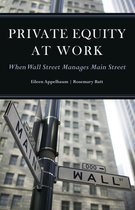
Private Equity at Work When Wall Street Manages Main Street
Je leest ebooks gemakkelijk op je kobo e-reader, of op je smartphone of tablet met de Kobo via bol app.
Samenvatting
Private equity firms have long been at the center of public debates on the impact of the financial sector on Main Street companies. Are these firms financial innovators that save failing businesses or financial predators that bankrupt otherwise healthy companies and destroy jobs? The first comprehensive examination of this topic, Private Equity at Work provides a detailed yet accessible guide to this controversial business model. Economist Eileen Appelbaum and Professor Rosemary Batt carefully evaluate the evidence—including original case studies and interviews, legal documents, bankruptcy proceedings, media coverage, and existing academic scholarship—to demonstrate the effects of private equity on American businesses and workers. They document that while private equity firms have had positive effects on the operations and growth of small and mid-sized companies and in turning around failing companies, the interventions of private equity more often than not lead to significant negative consequences for many businesses and workers. Prior research on private equity has focused almost exclusively on the financial performance of private equity funds and the returns to their investors. Private Equity at Work provides a new roadmap to the largely hidden internal operations of these firms, showing how their business strategies disproportionately benefit the partners in private equity firms at the expense of other stakeholders and taxpayers. In the 1980s, leveraged buyouts by private equity firms saw high returns and were widely considered the solution to corporate wastefulness and mismanagement. And since 2000, nearly 11,500 companies—representing almost 8 million employees—have been purchased by private equity firms. As their role in the economy has increased, they have come under fire from labor unions and community advocates who argue that the proliferation of leveraged buyouts destroys jobs, causes wages to stagnate, saddles otherwise healthy companies with debt, and leads to subsidies from taxpayers. Appelbaum and Batt show that private equity firms’ financial strategies are designed to extract maximum value from the companies they buy and sell, often to the detriment of those companies and their employees and suppliers. Their risky decisions include buying companies and extracting dividends by loading them with high levels of debt and selling assets. These actions often lead to financial distress and a disproportionate focus on cost-cutting, outsourcing, and wage and benefit losses for workers, especially if they are unionized. Because the law views private equity firms as investors rather than employers, private equity owners are not held accountable for their actions in ways that public corporations are. And their actions are not transparent because private equity owned companies are not regulated by the Securities and Exchange Commission. Thus, any debts or costs of bankruptcy incurred fall on businesses owned by private equity and their workers, not the private equity firms that govern them. For employees this often means loss of jobs, health and pension benefits, and retirement income. Appelbaum and Batt conclude with a set of policy recommendations intended to curb the negative effects of private equity while preserving its constructive role in the economy. These include policies to improve transparency and accountability, as well as changes that would reduce the excessive use of financial engineering strategies by firms. A groundbreaking analysis of a hotly contested business model, Private Equity at Work provides an unprecedented analysis of the little-understood inner workings of private equity and of the effects of leveraged buyouts on American companies and workers. This important new work will be a valuable resource for scholars, policymakers, and the informed public alike.
Productspecificaties
Inhoud
- Taal
- en
- Uitvoering
- E-book
- Oorspronkelijke releasedatum
- 31 maart 2014
Duidt aan welk type EPUB bestand het ebook is: EPUB, EPUB2 of EPUB3. EPUB3 is het meest toegankelijk.
- EPUB3
Duidt aan op welke manier het ebook beveiligd is. Deze informatie is niet relevant als je jouw bol-account hebt gekoppeld aan je Kobo e-reader of app. Wil je het ebook los downloaden, dan merk je bij DRM-vrij of watermerk niets. Staat hier Adobe DRM, dan heb je een (gratis) Adobe-programma nodig om het te kunnen downloaden.
- Adobe DRM
- Illustraties
- Met illustraties
Betrokkenen
- Hoofdauteur
- Tweede Auteur
- Hoofduitgeverij
Lees mogelijkheden
- Lees dit ebook op
- Windows (smartphone en tablet)Desktop (Mac en Windows)Kobo e-readerAndroid (smartphone en tablet)iOS (smartphone en tablet)
Toegankelijkheidsinformatie
Toegankelijkheidskenmerken tonen aan in hoeverre het ebook door iedere lezer, ook die met een beperking, gebruikt kan worden
- Aanpassingen mogelijk aan lettertype en tekstopmaakVisueel aanpasbaar
- Inhoud van Ebook Bevat
- Tekst
Mogelijke risico's die het gebruik van het ebook met zich meebrengen
- Geen gevaren bekend
Informatie over de fabrikant
- Fabrikantgegevens
- De informatie van de fabrikant is momenteel niet beschikbaar.
Overige kenmerken
- Studieboek
- Ja
EAN
- EAN
- 9781610448185
Productveiligheid
De verantwoordelijk marktdeelnemer in de EU zorgt voor het nakomen van verplichtingen op het gebied van productveiligheid.
Je vindt dit artikel in
- Categorieën
- Boek, ebook of luisterboek?
- Beschikbaarheid
- Taal
- Toegankelijkheidsinformatie
Documenten
Reviews
Kies gewenste uitvoering
Ebook is direct beschikbaar na aankoop
Ebooks lezen is voordelig
Dag en nacht klantenservice
Veilig betalen
- Houd er rekening mee dat je downloadartikelen niet kunt annuleren of retourneren. Bij nog niet verschenen producten kun je tot de verschijningsdatum annuleren.