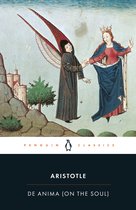
PC De Anima
Auteur:
Uitgever:
Vertaald door:
EngelsPaperback978014044471129 januari 1987256 pagina's

Aristotle
"Aristotle (/ˈærɪˌstɒtəl/; Greek: Ἀριστοτέλης Aristotélēs, pronounced [aristotélɛːs]; 384–322 BC)[n 1] was an ancient Greek philosopher and scientist born in the city of Stagira, Chalkidiki, in the north of Classical Greece. Along with Plato, Aristotle is considered the ""Father of Western Philosophy"", which inherited almost its entire lexicon from his teachings, including problems and methods of inquiry, so influencing almost all forms of knowledge.
(Bron: Wikipedia. Beschikbaar onder de licentie Creative Commons Naamsvermelding/Gelijk delen.)"
Alles van Aristotle(Bron: Wikipedia. Beschikbaar onder de licentie Creative Commons Naamsvermelding/Gelijk delen.)"
Samenvatting
For Plato the soul was the seat of being, metaphysically distinct from the body that it was forced temporarily to inhabit. In 'De Anima', Plato's student, Aristotle sought to set out his theory of soul as the ultimate reality of embodied form and produced a masterpiece of philosophical insight.
For the Pre-Socratic philosophers the soul was the source of movement and sensation, while for Plato it was the seat of being, metaphysically distinct from the body that it was forced temporarily to inhabit. Plato's student Aristotle was determined to test the truth of both these beliefs against the emerging sciences of logic and biology. His examination of the huge variety of living organisms - the enormous range of their behaviour, their powers and their perceptual sophistication - convinced him of the inadequacy both of a materialist reduction and of a Platonic sublimation of the soul. In De Anima, he sought to set out his theory of the soul as the ultimate reality of embodied form and produced both a masterpiece of philosophical insight and a psychology of perennially fascinating subtlety.
For the Pre-Socratic philosophers the soul was the source of movement and sensation, while for Plato it was the seat of being, metaphysically distinct from the body that it was forced temporarily to inhabit. Plato's student Aristotle was determined to test the truth of both these beliefs against the emerging sciences of logic and biology. His examination of the huge variety of living organisms - the enormous range of their behaviour, their powers and their perceptual sophistication - convinced him of the inadequacy both of a materialist reduction and of a Platonic sublimation of the soul. In De Anima, he sought to set out his theory of the soul as the ultimate reality of embodied form and produced both a masterpiece of philosophical insight and a psychology of perennially fascinating subtlety.
Productspecificaties
Inhoud
- Taal
- en
- Uitvoering
- Paperback
- Oorspronkelijke releasedatum
- 29 januari 1987
- Aantal pagina's
- 256
- Illustraties
- Nee
Vertaling
- Eerste Vertaler
Betrokkenen
- Hoofdauteur
- Tweede Auteur
- Hoofduitgeverij
Informatie over de fabrikant
- Fabrikant Naam
- Penguin Random House Ireland Limited
- Fabrikant Adres
- Morrison Chambers, 32 Nassau Street - D02 YH68 - Dublin - IE
- E-mailadres of online contactformulier van de fabrikant
- productsafety@penguin.co.uk
Overige kenmerken
- Extra groot lettertype
- Nee
- Porno
- Nee
- Product breedte
- 128 mm
- Product hoogte
- 15 mm
- Product lengte
- 200 mm
- Studieboek
- Ja
- Verpakking breedte
- 130 mm
- Verpakking hoogte
- 20 mm
- Verpakking lengte
- 199 mm
- Verpakkingsgewicht
- 184 g
EAN
- EAN
- 9780140444711
Productveiligheid
De verantwoordelijk marktdeelnemer in de EU zorgt voor het nakomen van verplichtingen op het gebied van productveiligheid.
Je vindt dit artikel in
Documenten
Reviews
Nog geen reviews
Kies gewenste uitvoering
Kies je uitvoering
Uiterlijk 30 oktober in huis
Gratis verzending door bol vanaf 25 euro
Ophalen bij een bol afhaalpunt mogelijk
30 dagen bedenktijd en gratis retourneren via mijn bol
Dag en nacht klantenservice
Doordeweeks ook ’s avonds in huis
Bekijk ook eens



Anderen bekeken ook
Bekijk de hele lijst