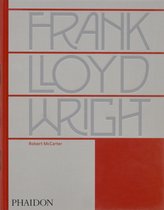
Frank Lloyd Wright
Vraag het Shophulp, de AI-assistent van bol
Uitgever:
EngelsPaperback978186189268301 februari 2006224 pagina's
Robert McCarter
"McCarter was born in Newton, New Jersey, in 1859 to Thomas Nesbitt and Mary Louisa (Haggerty) McCarter. He attended the Pingry School and Newark Academy before entering Princeton University, where he graduated in 1879. He studied at Columbia Law School, receiving his diploma in 1882, and was admitted to the New Jersey bar that same year.
(Bron: Wikipedia. Beschikbaar onder de licentie Creative Commons Naamsvermelding/Gelijk delen.)"
Alles van Robert McCarter(Bron: Wikipedia. Beschikbaar onder de licentie Creative Commons Naamsvermelding/Gelijk delen.)"
Samenvatting
Offers an account of Frank Lloyd Wright's life as an architect, the ideas, beliefs and relationships that shaped his life and work, and the manner in which these affected, and are reflected in, his architecture. This book shows how Wright was an architect of astonishing ability, whose works continue to shape the world around us.
The life and architecture of Frank Lloyd Wright (1867-1959) have been much-studied, yet there is a consistent division between analyses of his architecture, which exclude any discussion of his daily life, and books that tell the often sensational tale of his life, with barely a passing reference to the buildings themselves. The result is that, despite the large number of volumes on Wright, the most essential part of his life – his life as an architect, working, as he said, ‘in the cause of architecture’ – remains virtually unexplored. Frank Lloyd Wright offers an account of Wright’s life as an architect, the ideas, beliefs and relationships that shaped his life and work, and the manner in which these affected, and are reflected in, his architecture. During a tumultuous life and extensive career which includes such hugely defining buildings as the Guggenheim Museum, Fallingwater, Taliesin, Unity Temple, and the prolific Prairie Houses, Wright endeavoured to shape the emerging and evolving American democracy, its mode of dwelling, and its relation to the traditional conception of the city. Fusing ancient construction geometries with contemporary ideals of Transcendental philosophy, Wright sought to develop an appropriate architecture for the new world of the twentieth century. In doing so, he served as the primary inspiration for the emergence of Modern architecture around the world. Robert McCarter examines how Wright's architecture crystallized key conceptions of both private dwelling and public citizenship for American society, and relates how, through his work and writings, Wright developed relationships with key leaders of the arts, industry and society. He analyses how and why Wright maintained that architecture was the ‘background or framework’ for daily life, never the literal ‘object’ of our attention, as well as Wright's belief that architects have the most significant ethical responsibilities to improve the larger society and culture to which they belong. In exploring Wright's life, times and culture, Robert McCarter shows how Wright was an architect of astonishing ability, whose works continue to shape the world around us, fifty years after his death.
The life and architecture of Frank Lloyd Wright (1867-1959) have been much-studied, yet there is a consistent division between analyses of his architecture, which exclude any discussion of his daily life, and books that tell the often sensational tale of his life, with barely a passing reference to the buildings themselves. The result is that, despite the large number of volumes on Wright, the most essential part of his life – his life as an architect, working, as he said, ‘in the cause of architecture’ – remains virtually unexplored. Frank Lloyd Wright offers an account of Wright’s life as an architect, the ideas, beliefs and relationships that shaped his life and work, and the manner in which these affected, and are reflected in, his architecture. During a tumultuous life and extensive career which includes such hugely defining buildings as the Guggenheim Museum, Fallingwater, Taliesin, Unity Temple, and the prolific Prairie Houses, Wright endeavoured to shape the emerging and evolving American democracy, its mode of dwelling, and its relation to the traditional conception of the city. Fusing ancient construction geometries with contemporary ideals of Transcendental philosophy, Wright sought to develop an appropriate architecture for the new world of the twentieth century. In doing so, he served as the primary inspiration for the emergence of Modern architecture around the world. Robert McCarter examines how Wright's architecture crystallized key conceptions of both private dwelling and public citizenship for American society, and relates how, through his work and writings, Wright developed relationships with key leaders of the arts, industry and society. He analyses how and why Wright maintained that architecture was the ‘background or framework’ for daily life, never the literal ‘object’ of our attention, as well as Wright's belief that architects have the most significant ethical responsibilities to improve the larger society and culture to which they belong. In exploring Wright's life, times and culture, Robert McCarter shows how Wright was an architect of astonishing ability, whose works continue to shape the world around us, fifty years after his death.
Productspecificaties
Inhoud
- Taal
- en
- Uitvoering
- Paperback
- Oorspronkelijke releasedatum
- 01 februari 2006
- Aantal pagina's
- 224
- Illustraties
- Nee
Vertaling
- Originele titel
- Frank Lloyd Wright
Betrokkenen
- Hoofdauteur
- Tweede Auteur
- Co Auteur
- Hoofduitgeverij
- Tweede Uitgeverij
- Co Uitgever(s)
Informatie over de fabrikant
- Fabrikant Naam
- Libri GmbH
- E-mailadres of online contactformulier van de fabrikant
- gpsr@libri.de
- Fabrikantgegevens
- De overige informatie van de fabrikant is momenteel niet beschikbaar.
Overige kenmerken
- Extra groot lettertype
- Nee
- Kookboek
- Nee
- Porno
- Nee
- Product breedte
- 200 mm
- Product lengte
- 130 mm
- Studieboek
- Nee
- Verpakking breedte
- 130 mm
- Verpakking hoogte
- 11 mm
- Verpakking lengte
- 202 mm
- Verpakkingsgewicht
- 352 g
EAN
- EAN
- 9781861892683
Productveiligheid
De verantwoordelijk marktdeelnemer in de EU zorgt voor het nakomen van verplichtingen op het gebied van productveiligheid.
Je vindt dit artikel in
Documenten
Reviews
Nog geen reviews
Kies gewenste uitvoering
Kies je uitvoering
Verwacht over 3 weken
Prijs inclusief verzendkosten, verstuurd door bol
Ophalen bij een bol afhaalpunt mogelijk
30 dagen bedenktijd en gratis retourneren via mijn bol
Dag en nacht klantenservice
Doordeweeks ook ’s avonds in huis